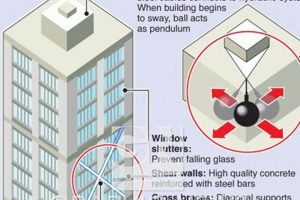



An earthquake proof skyscraper is a high-rise building designed to withstand earthquakes. These buildings are typically constructed using reinforced concrete or steel frames, and they are equipped with a variety of features to help them resist seismic forces. These features can include base isolators, which are devices that help to absorb the energy of an earthquake, and tuned mass dampers, which are devices that help to reduce the building’s vibrations.
Earthquake proof skyscrapers are important because they can help to protect people and property from the devastating effects of earthquakes. These buildings are often used to house critical infrastructure, such as hospitals and government buildings, and they can also provide shelter for people who have been displaced from their homes by an earthquake.
The first earthquake proof skyscraper was built in San Francisco in 1906, after the city was devastated by a major earthquake. Since then, earthquake proof skyscrapers have been built all over the world, and they have helped to save countless lives and protect property.
1. Structural design

Structural design is the process of designing a building to withstand the forces of gravity, wind, and earthquakes. In the case of earthquake proof skyscrapers, structural design is critical to ensuring that the building can withstand the forces of an earthquake without collapsing.
There are a number of different structural design features that can be used to make a building more earthquake resistant. These features include:
- Reinforced concrete: Reinforced concrete is a type of concrete that is reinforced with steel rods. This makes the concrete stronger and more resistant to cracking.
- Steel frames: Steel frames are a type of structural system that uses steel beams and columns to support the building. Steel frames are very strong and stiff, which makes them ideal for use in earthquake proof skyscrapers.
- Base isolation: Base isolation is a system that is used to isolate a building from the ground. This is achieved by placing the building on a layer of rubber or other flexible material. Base isolation can help to reduce the amount of force that is transferred to the building during an earthquake.
- Tuned mass dampers: Tuned mass dampers are devices that are used to reduce the vibrations of a building. These devices are typically made of a heavy weight that is attached to the building. The weight is tuned to the natural frequency of the building, which helps to reduce the building’s vibrations.
Structural design is an essential part of earthquake proof skyscrapers. By using the right structural design features, engineers can design buildings that are able to withstand the forces of an earthquake and protect the people inside.
Real-life examples
There are a number of real-life examples of earthquake proof skyscrapers that have successfully withstood the forces of an earthquake. One example is the Burj Khalifa in Dubai, which is the tallest building in the world. The Burj Khalifa is designed to withstand an earthquake of magnitude 8.0. Another example is the Taipei 101 in Taiwan, which is the tallest building in Taiwan. The Taipei 101 is designed to withstand an earthquake of magnitude 7.5.
These examples show that it is possible to design and build earthquake proof skyscrapers that are able to withstand the forces of an earthquake. By using the right structural design features, engineers can design buildings that are safe and protect the people inside.
2. Base isolation

Base isolation is a system that is used to isolate a building from the ground. This is achieved by placing the building on a layer of rubber or other flexible material. Base isolation can help to reduce the amount of force that is transferred to the building during an earthquake.
- Components
Base isolation systems typically consist of a layer of rubber or other flexible material that is placed between the building and the ground. The rubber layer is designed to absorb and dissipate the energy of an earthquake, preventing it from being transferred to the building. - Examples
Base isolation has been used in a number of earthquake proof skyscrapers, including the Burj Khalifa in Dubai and the Taipei 101 in Taiwan. These buildings have successfully withstood the forces of major earthquakes, demonstrating the effectiveness of base isolation. - Implications
Base isolation can significantly reduce the amount of force that is transferred to a building during an earthquake. This can help to prevent the building from collapsing and protect the people inside.
Base isolation is an important part of earthquake proof skyscraper design. By using base isolation, engineers can design buildings that are able to withstand the forces of an earthquake and protect the people inside.
3. Tuned mass dampers

Tuned mass dampers (TMDs) are devices that are used to reduce the vibrations of a building. These devices are typically made of a heavy weight that is attached to the building. The weight is tuned to the natural frequency of the building, which helps to reduce the building’s vibrations.
TMDs are an important part of earthquake proof skyscraper design. By reducing the building’s vibrations, TMDs can help to prevent the building from collapsing during an earthquake. TMDs have been used in a number of earthquake proof skyscrapers, including the Burj Khalifa in Dubai and the Taipei 101 in Taiwan. These buildings have successfully withstood the forces of major earthquakes, demonstrating the effectiveness of TMDs.
The use of TMDs in earthquake proof skyscrapers is a practical application of the principles of structural engineering. By understanding the natural frequency of a building and by designing a TMD that is tuned to that frequency, engineers can design buildings that are able to withstand the forces of an earthquake.
4. Seismic dampers

Seismic dampers are devices that are used to reduce the vibrations of a building during an earthquake. These devices are typically made of a viscous fluid or a metal alloy, and they are placed in the building’s structural frame. When the building vibrates, the fluid or alloy in the damper moves, and this helps to dissipate the energy of the vibration.
Seism
ic dampers are an important part of earthquake proof skyscraper design. By reducing the building’s vibrations, seismic dampers can help to prevent the building from collapsing during an earthquake. Seismic dampers have been used in a number of earthquake proof skyscrapers, including the Burj Khalifa in Dubai and the Taipei 101 in Taiwan. These buildings have successfully withstood the forces of major earthquakes, demonstrating the effectiveness of seismic dampers.
The use of seismic dampers in earthquake proof skyscrapers is a practical application of the principles of structural engineering. By understanding the natural frequency of a building and by designing seismic dampers that are tuned to that frequency, engineers can design buildings that are able to withstand the forces of an earthquake.
5. Reinforced concrete

Reinforced concrete is a type of concrete that is reinforced with steel rods. This makes the concrete stronger and more resistant to cracking, which is important for earthquake proof skyscrapers.
- Strength
Reinforced concrete is much stronger than. This is because the steel rods help to carry the load and prevent the concrete from cracking. This strength is essential for earthquake proof skyscrapers, which need to be able to withstand the forces of an earthquake without collapsing. - Ductility
Reinforced concrete is also more ductile than ordinary concrete. This means that it can deform under stress without breaking. This ductility is important for earthquake proof skyscrapers, which need to be able to sway and flex without collapsing during an earthquake. - Durability
Reinforced concrete is also more durable than ordinary concrete. This is because the steel rods help to protect the concrete from corrosion and other environmental factors. This durability is important for earthquake proof skyscrapers, which need to be able to withstand the forces of an earthquake over a long period of time.
Reinforced concrete is an essential material for earthquake proof skyscrapers. Its strength, ductility, and durability make it ideal for this application. Reinforced concrete has been used in the construction of many earthquake proof skyscrapers around the world, including the Burj Khalifa in Dubai and the Taipei 101 in Taiwan. These buildings have successfully withstood the forces of major earthquakes, demonstrating the effectiveness of reinforced concrete in earthquake-resistant construction.
6. Steel frames

Steel frames are a vital component of earthquake proof skyscrapers. They provide the building with the strength and rigidity it needs to withstand the forces of an earthquake.
- Strength
Steel is one of the strongest materials available, and it is this strength that makes it so well-suited for use in earthquake proof skyscrapers. Steel frames can support the weight of the building and its occupants, and they can also resist the lateral forces that are generated by an earthquake. - Rigidity
Steel frames are also very rigid, which means that they do not deform easily. This rigidity is important for earthquake proof skyscrapers because it helps to prevent the building from swaying or collapsing during an earthquake. - Ductility
In addition to being strong and rigid, steel frames are also ductile, which means that they can deform without breaking. This ductility is important for earthquake proof skyscrapers because it allows the building to absorb the energy of an earthquake without collapsing. - Examples
Steel frames have been used in the construction of many earthquake proof skyscrapers around the world, including the Burj Khalifa in Dubai and the Taipei 101 in Taiwan. These buildings have successfully withstood the forces of major earthquakes, demonstrating the effectiveness of steel frames in earthquake-resistant construction.
Steel frames are an essential part of earthquake proof skyscrapers. Their strength, rigidity, and ductility make them ideal for this application. By using steel frames, engineers can design earthquake proof skyscrapers that are able to withstand the forces of an earthquake and protect the people inside.
7. Energy dissipation

Energy dissipation is the process of converting the energy of an earthquake into another form of energy, such as heat or sound. This is an important part of earthquake-resistant design, as it can help to reduce the amount of damage caused by an earthquake.
- Structural damping
Structural damping is the ability of a building to absorb and dissipate energy through its structure. This can be achieved through the use of materials that are good at absorbing energy, such as steel or concrete, or by using structural elements that are designed to dissipate energy, such as shear walls or moment frames.
- Non-structural damping
Non-structural damping is the ability of a building to absorb and dissipate energy through its non-structural elements, such as furniture, partitions, and cladding. This can be achieved through the use of materials that are good at absorbing energy, such as gypsum board or carpeting, or by using non-structural elements that are designed to dissipate energy, such as energy-absorbing panels.
- Active damping
Active damping is the use of external devices to absorb and dissipate energy from a building. These devices can be used to control the vibrations of a building during an earthquake, and can be used to reduce the amount of damage caused by an earthquake.
Energy dissipation is an important part of earthquake-resistant design. By using a combination of structural damping, non-structural damping, and active damping, engineers can design buildings that are able to withstand the forces of an earthquake and protect the people inside.
8. Seismic resistance

Seismic resistance is the ability of a structure to withstand the forces of an earthquake. Earthquake proof skyscrapers are designed to be seismically resistant, meaning that they are able to withstand the forces of an earthquake without collapsing or causing serious damage.
Seismic resistance is important for earthquake proof skyscrapers because it helps to protect the people inside the building from injury or death. Earthquakes can cause buildings to collapse, which can trap people inside and cause serious injuries or death. Seismic resistance helps to prevent this from happening by ensuring that the building is able to withstand the forces of an earthquake and remain standing.
There are a number of different ways to make a building seismically resistant. One common method is to use a steel frame. Steel frames are very strong and stiff, which helps to resist the forces of an earthquake. Another common method is to use base isolation. Base i
solation is a system that isolates the building from the ground, which helps to reduce the amount of force that is transferred to the building during an earthquake.
Seismic resistance is an important part of earthquake proof skyscraper design. By using a combination of structural and non-structural measures, engineers can design earthquake proof skyscrapers that are able to withstand the forces of an earthquake and protect the people inside.
9. Building codes and earthquake proof skyscrapers
Building codes play a critical role in ensuring that earthquake proof skyscrapers are safe and resilient. These codes specify the minimum design requirements for buildings in earthquake-prone areas, including structural design, materials, and construction methods.
- Structural design
Building codes specify the minimum structural requirements for earthquake proof skyscrapers, including the use of reinforced concrete or steel frames, and the inclusion of seismic design features such as base isolation and tuned mass dampers.
- Materials
Building codes specify the minimum quality and strength of materials used in the construction of earthquake proof skyscrapers, including concrete, steel, and glass.
- Construction methods
Building codes specify the minimum construction methods for earthquake proof skyscrapers, including the use of proper construction techniques, skilled labor, and quality control measures.
- Inspections
Building codes require that earthquake proof skyscrapers be inspected regularly to ensure that they are in compliance with the code and are safe for occupancy.
Building codes are essential for ensuring that earthquake proof skyscrapers are safe and resilient. By following these codes, architects and engineers can design and construct buildings that are able to withstand the forces of an earthquake and protect the people inside.
FAQs
This section provides answers to common questions about earthquake proof skyscrapers.
Question 1: What are earthquake proof skyscrapers?
Answer: Earthquake proof skyscrapers are high-rise buildings designed to withstand the forces of an earthquake. These buildings are typically constructed using reinforced concrete or steel frames, and they are equipped with a variety of features to help them resist seismic forces. These features can include base isolators, which are devices that help to absorb the energy of an earthquake, and tuned mass dampers, which are devices that help to reduce the building’s vibrations.
Question 2: Why are earthquake proof skyscrapers important?
Answer: Earthquake proof skyscrapers are important because they can help to protect people and property from the devastating effects of earthquakes. These buildings are often used to house critical infrastructure, such as hospitals and government buildings, and they can also provide shelter for people who have been displaced from their homes by an earthquake.
Question 3: How are earthquake proof skyscrapers designed?
Answer: Earthquake proof skyscrapers are designed using a variety of structural and non-structural measures to resist the forces of an earthquake. Structural measures include the use of reinforced concrete or steel frames, and the inclusion of seismic design features such as base isolation and tuned mass dampers. Non-structural measures include the use of energy-absorbing materials and the installation of seismic dampers.
Question 4: Are earthquake proof skyscrapers safe?
Answer: Earthquake proof skyscrapers are designed to be safe and resilient, even in the event of a major earthquake. However, no building is completely earthquake-proof, and there is always some risk of damage or collapse in the event of a very large earthquake.
Question 5: How can I tell if a building is earthquake proof?
Answer: There are a few things you can look for to determine if a building is earthquake proof. First, check to see if the building has been designed by a qualified structural engineer and if it has been constructed in accordance with the relevant building codes. Second, look for evidence of seismic design features, such as base isolation or tuned mass dampers. Finally, you can contact the local building department to inquire about the building’s seismic safety.
Question 6: What should I do if I am in an earthquake proof skyscraper during an earthquake?
Answer: If you are in an earthquake proof skyscraper during an earthquake, the best thing to do is to stay calm and follow the instructions of the building’s emergency plan. Typically, this will involve staying indoors and away from windows, and taking cover under a sturdy table or desk.
Summary: Earthquake proof skyscrapers are an important part of urban planning in earthquake-prone areas. These buildings provide a safe haven for people to live and work, and they help to protect critical infrastructure from damage. By investing in earthquake proof skyscrapers, we can help to reduce the risk of damage and loss of life in the event of an earthquake.
Transition to the next article section: For more information on earthquake proof skyscrapers, please see the following resources:
- FEMA: Earthquake
- Strong Motion Center
- Earthquake Engineering Research Institute
Tips for Earthquake Proof Skyscrapers
In earthquake-prone areas, earthquake proof skyscrapers are essential for protecting people and property. By following these tips, architects and engineers can design and construct earthquake proof skyscrapers that are safe and resilient.
Tip 1: Use a strong and ductile structural system.
The structural system is the backbone of an earthquake proof skyscraper. It must be able to withstand the lateral forces of an earthquake without collapsing. Steel frames and reinforced concrete are two common structural systems used in earthquake proof skyscrapers. These systems are strong and ductile, meaning that they can deform without breaking.
Tip 2: Include seismic design features.
Seismic design features are devices and systems that help to reduce the effects of an earthquake on a building. These features can include base isolators, tuned mass dampers, and seismic dampers. Base isolators are placed between the building and the ground, and they help to absorb the energy of an earthquake. Tuned mass dampers are attached to the building, and they help to reduce the building’s vibrations. Seismic dampers are also attached to the building, and they help to dissipate the energy of an earthquake.
Tip 3: Use high-quality materials.
The materials used in the construction of an earthquake proof skyscraper must be of high quality. Concrete, steel, and glass are the most common materials used in earthquake proof skyscrapers. These materials must be strong and durable, and they must be able to withstand the forces of an earthquake.
Tip 4: Follow building codes.
Building codes are essential for ensuring that earthquake proof skyscrapers are safe and resilient. Building codes specify the minimum design requirements for buildings in earthquake-prone a
reas. By following building codes, architects and engineers can design and construct earthquake proof skyscrapers that meet the highest standards of safety.
Tip 5: Conduct regular inspections.
Regular inspections are essential for ensuring that earthquake proof skyscrapers remain safe and resilient. Inspections should be conducted by qualified professionals, and they should include a visual inspection of the building’s structural system and seismic design features. Inspections should also include a review of the building’s maintenance records.
Summary: By following these tips, architects and engineers can design and construct earthquake proof skyscrapers that are safe and resilient. These buildings can help to protect people and property from the devastating effects of earthquakes.
Transition to the conclusion: For more information on earthquake proof skyscrapers, please see the following resources:
- FEMA: Earthquake
- Strong Motion Center
- Earthquake Engineering Research Institute
Conclusion
Earthquake proof skyscrapers are an important part of urban planning in earthquake-prone areas. These buildings provide a safe haven for people to live and work, and they help to protect critical infrastructure from damage. By investing in earthquake proof skyscrapers, we can help to reduce the risk of damage and loss of life in the event of an earthquake.
The design and construction of earthquake proof skyscrapers is a complex and challenging task. However, by following the tips outlined in this article, architects and engineers can design and construct earthquake proof skyscrapers that are safe and resilient. These buildings can help to protect people and property from the devastating effects of earthquakes.